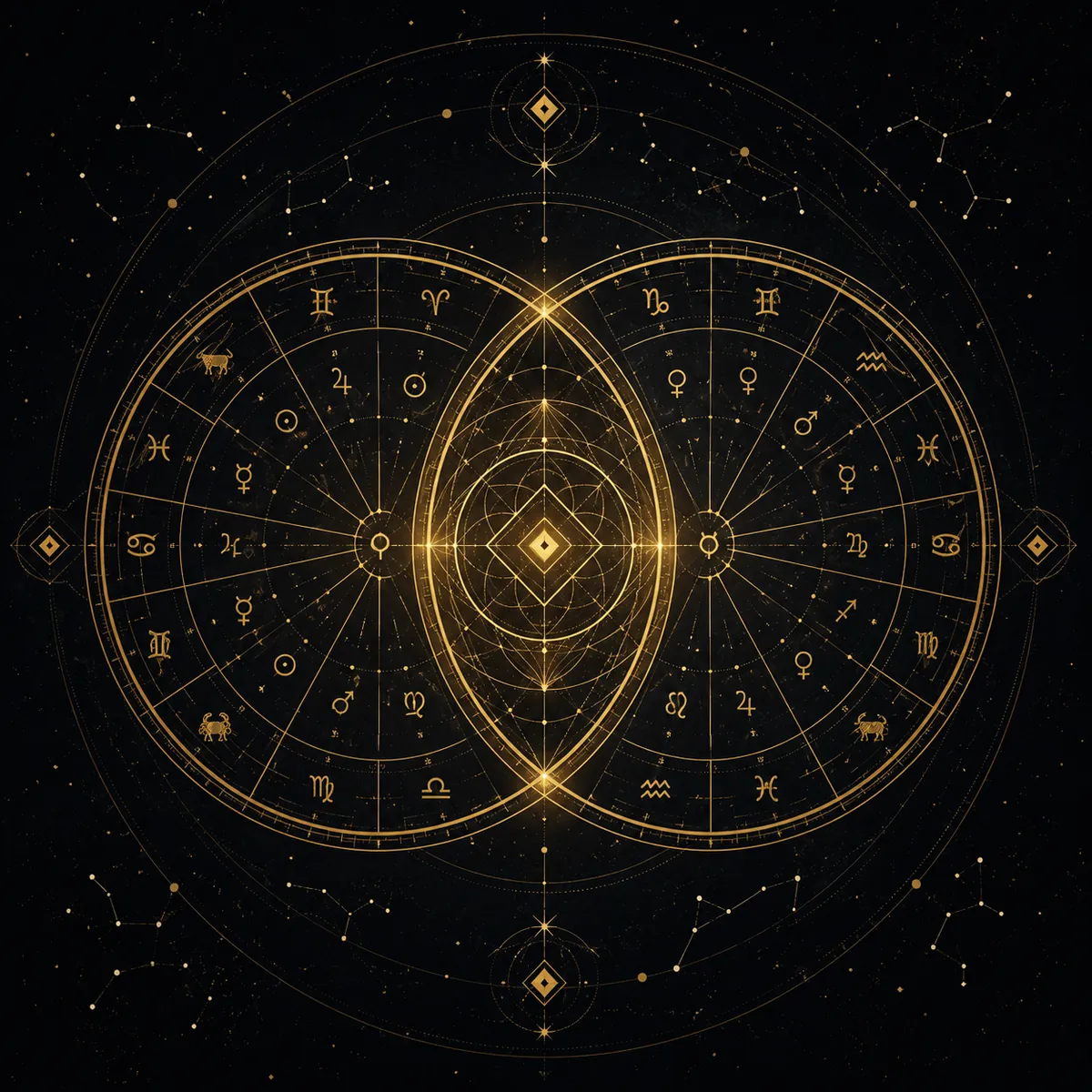
Marriage Compatibility Report
Assess long-term marital harmony, temperament fit, and timing between two charts.
What this reading reveals
Assess long-term marital harmony, temperament fit, and timing between two charts.
What it is built from
- 01Your Chart at a Glance
- 02Executive Summaryfree preview
- 03Detailed Astrological Interpretation
- 04Planet-by-Planet Analysis
- 05Compatibility & Koota Analysis
- 06Relevant Yogas
- 07Relevant Dasha Impacts
- 08Strengths
- 09Challenges
- 10Opportunities
- 11Recommendations
- 12Important Time Periods
- 13Conclusion
Are we compatible for marriage? That question holds every hope and every hesitation of two people standing at the edge of a life together, and your birth charts answer it with more depth than any quiz can reach.
In short
Vedic compatibility is read from four layers: the Ashtakoota (Guna Milan) score across eight moon-nakshatra factors, Navamsa synastry between the two D9 charts, Mangal dosha matching and its cancellations, and dasha alignment to confirm that both charts open a marriage window at the same time. No single layer decides compatibility; all four read together give the real picture.
Key takeaways
- Ashtakoota Guna Milan scores nakshatra compatibility across eight dimensions; above 18 of 36 is broadly acceptable, but the score is never the whole picture.
- Navamsa (D9) synastry reveals how the inner natures of two people match, often telling a different story than the birth chart alone.
- Mangal dosha matters far less than its reputation, and it cancels under many common configurations that a reading checks first.
- Dasha alignment confirms that both partners are in life phases that support commitment at the same time.
- The 7th, 8th, 2nd, and 4th houses in each chart are read for partnership quality, longevity, family values, and emotional security.
- A high Guna score with poor Navamsa synastry can still produce friction; a modest score with strong D9 alignment often produces a lasting bond.
Are we compatible for marriage, according to Vedic astrology?
Vedic astrology does not answer compatibility with a single number or a pass-fail verdict. It answers it with a structure, a layered reading that weighs the emotional attunement of the Moon signs, the inner character of the Navamsa charts, the Mars energy each partner carries, and the dasha phases that tell whether both are ready for the same life chapter at the same time. Two people can score very differently on each layer and still be deeply suited; a reading that stops at the Guna score is stopping at the surface.
The classical framework for compatibility is the Ashtakoota system, which compares eight dimensions of the couple's natal Moons and nakshatras to produce a score out of 36. This is the system most families know by name, and it is genuinely informative, but it is one layer among four. The Navamsa (D9) synastry, which compares the marriage-specific divisional charts, often reveals qualities the birth chart and Guna score do not surface. Mangal dosha matching addresses the Mars energy in the marriage houses. And dasha alignment checks whether both partners are opening toward commitment at the same life moment.
A full compatibility reading uses all four layers together, notes where they agree and where they diverge, and arrives at a picture that is specific to these two charts rather than generic to their sun signs. The sections below walk through each layer so you understand exactly what a matching analysis reads and why.
What is the Ashtakoota Guna Milan score, and how is it read?
Ashtakoota Guna Milan is the classical Vedic compatibility scoring system that compares eight qualities of a couple's birth Moon nakshatras. The eight factors (Varna, Vasya, Tara, Yoni, Graha Maitri, Gana, Bhakuta, and Nadi) each carry a point value, totalling 36. A score above 18 is considered broadly acceptable in classical guidance; above 24 is considered good; above 28 is considered excellent. Below 18 warrants closer examination of the other compatibility layers before recommending the match.
Each of the eight factors measures a different dimension of compatibility. Nadi (nerve energy and health, worth 8 points) and Bhakuta (emotional and financial harmony across Moon signs, worth 7 points) carry the most weight and have the strongest classical prohibitions when afflicted. Yoni (sexual and temperamental harmony, worth 4 points) and Gana (temperamental nature, whether the partners are deva, manushya, or rakshasa by nature, worth 6 points) follow. Varna (dharmic compatibility, 1 point), Vasya (attraction and control dynamics, 2 points), Tara (birth-star harmony, 3 points), and Graha Maitri (planetary friendship between Moon-sign lords, 5 points) complete the picture.
The score is useful but must always be read in context. A couple with a score of 20 and strong Navamsa synastry, compatible Mangal placements, and well-aligned dashas often has a more sustainable match than a couple with a score of 30 and a conflicting Navamsa. Classical texts name several override conditions too, where a high Nadi or Bhakuta affliction is cancelled by other chart factors. A number without context is an incomplete reading.
Nadi dosha and Bhakuta dosha: how serious are they?
Nadi dosha and Bhakuta dosha are the two most serious afflictions within the Ashtakoota system, and they are also the two most commonly misrepresented. Nadi dosha occurs when both partners share the same Nadi classification (Aadi, Madhya, or Antya), and classical texts associate it with health challenges in the marriage or difficulties with children. Bhakuta dosha occurs when the Moon signs of the couple fall in certain counted relationships (6/8 or 9/5 from each other), and it is associated with financial and emotional strain.
Both doshas have well-documented cancellation conditions. Nadi dosha is cancelled when the partners share the same nakshatra but different padas, when the Moon signs are identical, when the 7th lords are in mutual friendly signs, or when Jupiter aspects the relevant houses in either chart. Bhakuta dosha is reduced significantly when Graha Maitri (the planetary friendship factor) is high or when Rashi lords are mutually friendly. Classical astrologers check these cancellations before drawing any conclusion.
The practical point is that Nadi and Bhakuta doshas affect the score and deserve attention, but they do not automatically block a match. They are indicators that call for closer examination of the Navamsa, the individual charts' strength, and the specific cancellation conditions. A reading that names the dosha without checking the cancellations is giving only half the answer.
Which houses are read for compatibility in each chart?
Beyond the Guna score, a compatibility reading examines specific houses in both individual charts to understand what each partner brings to the marriage and what the marriage will look like from both sides. The 7th house governs partnership itself: its lord, any planets in it, and its condition in the Navamsa together describe the partner each person is suited to and the texture of their married life. When the two charts' 7th houses complement each other, the match gains strength regardless of the Guna score.
The 8th house is read for longevity and transformation within the marriage. A well-supported 8th in both charts suggests a relationship that can sustain difficulty and deepen over time. The 2nd house governs family, speech, and accumulated values; compatibility here reflects shared life priorities and family harmony, which becomes especially relevant when two families are joining. The 4th house governs emotional security, home, and the inner life; when the 4th houses of two charts are sympathetic to each other, the partners tend to create a home environment that genuinely nourishes both.
The Moon is the most important planet in a compatibility reading because it governs emotional nature, habitual responses, and the inner world that a partner lives in most intimately. The relationship between the two natal Moons, by sign, nakshatra, and aspect, is the emotional thread that runs through every house analysis. When the Moons support each other, the relationship has a quality of emotional ease that sustains it through the inevitable difficulties that every long marriage contains.
Mangal dosha in compatibility: matching and cancellation
Mangal dosha, or Kuja dosha, occurs when Mars sits in the 1st, 2nd, 4th, 7th, 8th, or 12th house of the birth chart, and it is one of the most discussed factors in Indian marriage matching. The classical concern is that Mars energy, which is fiery and assertive, directed at the marriage houses can create friction in partnership if it is not balanced. The traditional remedy is to match a Manglik partner with another Manglik partner, so that the Mars energy in both charts balances rather than clashes.
Cancellation conditions are extensive, and a responsible reading always applies them before labelling a chart Manglik in a way that affects the match. Mars in its own sign or in exaltation within the relevant house often cancels the dosha. Jupiter aspecting Mars, Mars in a house owned by Venus or Jupiter, Rahu co-placed with Mars, or both partners having the dosha are among the most commonly applied cancellations. Mars in the 2nd house being excluded from the dosha count is another position taken by several classical authorities.
The most important practical point is that Mangal dosha should never be used to reject a match on its own. When the Guna score is reasonable, the Navamsa synastry is supportive, and the Mangal dosha either has cancellations or is present in both charts, the Mars placement is a manageable factor rather than a dealbreaker. The fear around Manglik status in popular astrology is disproportionate to what the classical texts actually say.
Venus, Jupiter, and the Darakaraka in compatibility
Venus and Jupiter are the significators of marriage and spouse for every chart, and their relationship between two charts is one of the most meaningful compatibility indicators. When one person's Venus falls favourably in the other's chart, especially in or around the 7th house or the Moon, there is often a quality of genuine attraction and aesthetic resonance between the partners. When Jupiter from one chart aspects the 7th house or Moon of the other, there is a protective and expansive quality to the relationship.
The Darakaraka, in Jaimini astrology the planet with the lowest degree in the chart, represents the spouse most directly. Comparing the Darakarakas of two charts can reveal whether the spouse each person is karmically oriented toward is the kind of person the other actually is. A Darakaraka reading sits alongside the classical Parashari analysis as a complementary lens, and when both agree, confidence in the compatibility picture rises.
Venus's sign, nakshatra, and Navamsa placement are also compared across the two charts, looking for whether the Venus principles of each partner, what each person desires in love and values in a relationship, resonate or conflict. Two charts where Venus occupies mutually friendly signs and nakshatras tend to share a natural aesthetic and romantic wavelength that sustains attraction over time.
Why dasha alignment matters for marriage timing
Two charts can be deeply compatible in terms of Guna score and Navamsa synastry and still not marry each other, if their dasha periods are not pointing toward marriage at the same time. Dasha alignment is the compatibility layer that addresses timing: are both people in a life phase where commitment is indicated, and do those phases overlap? When one partner is in a marriage-significant dasha and the other is in a career-consolidation or foreign-travel period, the mismatch in life chapters can prevent even a well-matched pair from moving forward.
Reading dasha alignment starts with identifying the marriage-significant periods in each chart: the dasha and antardasha of the 7th lord, Venus, Jupiter, or any planet connected to the 7th house. Then the two timelines are compared to find the window where both charts open toward partnership at the same time. This window is the optimal period for the relationship to move from courtship to commitment, and it is often specific enough to narrow things to a range of one to three years.
When a couple meets and feels immediate compatibility but the timing feels uncertain, dasha alignment often explains why. One or both charts may not yet be in a marriage-significant period. Rather than interpreting this as incompatibility, a reading can identify when the timing window opens and what the couple can do in the interim. This is one of the most practically useful outputs a compatibility reading provides.
Compatibility scoring at a glance: what each layer tells you
The four layers of a Vedic compatibility reading each contribute a different kind of information. Reading them together, rather than elevating one above the others, is what produces a reliable picture. The table below summarises what each layer measures and what a strong versus weak reading in that layer signals.
| Layer | What it measures | What to look for |
|---|---|---|
| Ashtakoota Guna Milan | Eight nakshatra and Moon-sign compatibility dimensions, scored out of 36 | Above 18 broadly acceptable; check Nadi and Bhakuta doshas and their cancellations |
| Navamsa (D9) synastry | Inner-nature compatibility across the marriage-specific divisional charts | Mutual ascendant-lord placement, Venus and Jupiter in supportive positions across charts |
| Mangal dosha matching | Mars energy in the marriage houses of each chart | Dosha present in both charts or cancellation conditions met reduces or removes concern |
| Dasha alignment | Whether both partners are in marriage-supportive life phases at the same time | Overlapping marriage-significant dashas confirm readiness and timing |
| 7th house reading | Partnership quality in each individual chart | Compatible 7th lords and occupants suggest mutually supportive marriage styles |
| Moon relationship | Emotional attunement and inner-life resonance | Moons in friendly signs or nakshatras; 5/9 relationship between Moon signs is especially supportive |
Why a high Guna score does not guarantee a happy marriage
The most common misconception about Vedic compatibility is that a high Guna score means a happy marriage and a low score means a troubled one. This is not what the classical system says. The Guna score assesses one dimension of compatibility, the nakshatra and Moon-sign resonance, and it does so through a system that was developed for a specific cultural context. A score of 36 out of 36 with a conflicting Navamsa synastry, unaddressed Mars placements, and misaligned dashas can still produce a difficult marriage.
Conversely, a score of 18 to 22 with excellent Navamsa alignment, both charts promising a strong and enduring 7th house, and well-matched dashas often produces a deeply fulfilling partnership. The score is a starting point, a signal about nakshatra resonance, not a verdict about life satisfaction. This is why classical astrologers developed the full four-layer reading rather than relying on the Guna score alone.
The qualities that sustain a marriage, emotional maturity, shared values, genuine affection, and the willingness to work through difficulty, are character qualities that appear in the Moon, the 4th house, the 2nd house, and the overall strength of the two individual charts. A compatibility reading cannot substitute for knowing another person, but it can describe the terrain the two charts create together, which is useful preparation for anyone entering a life commitment.
Can compatibility charts predict difficulties or a second marriage?
Indicators of serious difficulty in a marriage are read from specific stress on the 7th and 8th houses in both individual charts, confirmed in the Navamsa, combined with incompatibility signals in the matching analysis. A couple where both charts carry heavy affliction on the marriage axis and where the Guna score is low and the Navamsa synastry is conflicting carries a different risk profile than one where only one layer shows stress. Even then, individual chart strength, dasha support, and character qualities all shape the outcome.
The possibility of a second marriage is read from the individual charts rather than from the compatibility reading between two specific people. A second marriage in the individual chart is indicated by dual signs on the marriage axis, certain Rahu or Ketu placements, heavy affliction to the 7th lord, or the 7th lord placed in a way that repeats or divides partnership. These indicators in one or both charts are worth noting in a compatibility reading because they give the couple realistic information about what the charts suggest for stability.
The honest use of this part of a reading is not to frighten but to inform. When indicators of difficulty appear, the reading names the specific periods of stress and the specific periods of support, gives the couple a timeline of when the marriage axis is under pressure and when it is strengthened, and offers remedial guidance. That is more useful than either ignoring the indicators or treating them as a fixed fate.
Remedies for compatibility doshas
When a compatibility reading finds genuine afflictions that the usual cancellations do not resolve, classical Vedic guidance offers specific remedial measures for the couple to undertake together. These are designed to strengthen the marriage significators and soften the friction the dosha introduces, rather than magically override the chart. Joint worship of the appropriate deity, particularly Vishnu, Lakshmi, or Parvati-Shiva for marriage harmony, is among the most commonly recommended.
For Nadi dosha, the remedies often include the Maha Mrityunjaya mantra, Parvati-Shiva puja, and specific charitable acts, sometimes performed at a temple. For Bhakuta dosha, Jupiter strengthening practices and charitable acts aligned to the planets whose Moon signs are in conflict are commonly advised. For Mangal dosha, the classical remedy, when the dosha is not cancelled by chart conditions, includes Mars propitiation through Mangal puja and fasting on Tuesdays.
The honest framing is the same as for individual chart remedies: they support and align rather than force. A couple with genuine affection, shared values, and a willingness to work through difficulty will benefit from remedies that cooperate with the chart's open windows; a couple without those foundations will not find an astrologer's remedy a substitute. A compatibility reading is most valuable when it is used as a preparation and a guide, not as a final word on whether love is possible.
Compatibility for inter-caste, inter-community, and international couples
The Ashtakoota system was developed within a specific social context where Varna compatibility was one of its eight factors, and a modern reading applies the system thoughtfully. For inter-caste, inter-community, or international couples, the seven remaining factors carry the weight, and the Navamsa synastry, Mangal matching, and dasha alignment often matter more than the Varna score. Classical texts themselves offer override conditions for Varna mismatch when other factors are strong.
Rahu's influence on the marriage houses in one or both charts is associated classically with cross-community or cross-cultural unions. Far from being an affliction, a Rahu-influenced 7th or Venus can describe exactly the kind of union an international couple is experiencing, a relationship that crosses conventional boundaries and introduces novelty and growth into the partnership. Reading this as a dosha in a cross-cultural context is a category error.
The principles underlying compatibility, emotional attunement, shared values, mutual support, and timing, are human universals rather than community-specific, and the Vedic reading serves any couple that comes to it. The sophistication of the Navamsa synastry and dasha alignment layers especially makes the system applicable well beyond the traditional matching context for which the Guna score was first designed.
How to assess your compatibility, step by step
You can apply this framework to your own charts in a clear sequence. First, identify the natal Moon signs and nakshatras of both partners and calculate the Ashtakoota score across all eight factors, noting which of the high-value doshas (Nadi, Bhakuta) are present and whether their cancellation conditions apply. Second, pull the Navamsa (D9) chart of each partner and compare the ascendants, the 7th houses, and the placement of Venus and Jupiter in each, looking for cross-chart support or conflict.
Third, check for Mangal dosha in both charts, applying the cancellation conditions before drawing any conclusion. Fourth, map the Vimshottari dasha timelines of both partners and look for the window where both are in marriage-significant periods at the same time. Fifth, read the 7th, 8th, 2nd, and 4th houses in each individual chart and note where the two charts' marriage areas complement or challenge each other. Sixth, compare the natal Moons for sign friendship, nakshatra relationship, and the quality of emotional attunement.
This is exactly the analysis the Marriage Compatibility Report performs on your two specific charts, with your real Guna scores, your Navamsa synastry, your Mangal placements and their cancellations, and your aligned dasha windows. Generate both charts on Kalmanas to see your Navamsa, your dasha timelines, and your 7th house placements, and let the report bring them together into a compatibility picture you can actually use.
Frequently asked questions
What is a good Guna Milan score for marriage?
Classically, 18 or more out of 36 is considered broadly acceptable, 24 or more is good, and 28 or more is excellent. However, the score must be read with the cancellation conditions for any doshas and alongside the Navamsa synastry, Mangal matching, and dasha alignment. A score of 22 with strong D9 synastry often produces a better match than a score of 30 with a conflicting Navamsa.
Is Nadi dosha very serious?
Nadi dosha, where both partners share the same Nadi (Aadi, Madhya, or Antya), is the highest-weighted dosha in Ashtakoota and is associated with health and progeny challenges. However, it has specific cancellation conditions: same nakshatra but different padas, identical Moon signs, or friendly 7th lords often cancel or significantly reduce it. A reading always checks these before treating the dosha as decisive.
Does a Manglik person have to marry another Manglik?
Traditional guidance recommends matching a Manglik with another Manglik so the Mars energies balance. However, Mangal dosha itself cancels under many conditions (Mars in its own sign, Jupiter aspecting Mars, Rahu co-placed, and others), and the strength of the overall chart matters more than a single placement. A blanket prohibition against Manglik-non-Manglik marriages is not supported by careful classical reading.
What does the Navamsa (D9) show in compatibility matching?
The Navamsa reveals the inner natures of both partners as they emerge in long-term committed partnership. Comparing the two D9 charts, looking at Navamsa ascendants, the 7th house in each D9, and the placement of Venus and Jupiter, often shows qualities of compatibility or friction that the birth chart and Guna score do not surface. It is one of the most important layers in a full compatibility reading.
What happens if the Guna score is low but we are in love?
A low Guna score means one layer of the reading shows concern, not that the match is wrong. The Navamsa synastry, Mangal matching, individual chart strengths, and dasha alignment are all considered together. Many successful marriages rest on modest Guna scores with strong D9 alignment and complementary individual charts. The score is a starting point for deeper analysis, not a verdict.
Can Vedic astrology tell us when to get married?
Yes, through dasha alignment. A compatibility reading identifies the window where both partners are simultaneously in marriage-significant dashas (periods of the 7th lord, Venus, Jupiter, or planets connected to the 7th house), overlaid with supportive Jupiter and Saturn transits. This overlap is the optimal timing window for commitment, and it can often be narrowed to one to three years.
Is inter-community or inter-caste marriage shown in the chart?
Rahu's influence on the marriage houses or Venus in a cross-sign or cross-community signature is classically associated with unconventional or cross-community unions. A 7th lord connected to the 12th house or a foreign sign can indicate a partner from a different background. These are descriptive chart signatures, not prohibitions, and a cross-cultural match is assessed on the same four compatibility layers as any other.
Which factor is most important in Vedic compatibility matching?
No single factor is decisive. Nadi and Bhakuta carry the most points in Ashtakoota and deserve close attention, but Navamsa synastry is often more revealing of long-term compatibility. The Moon relationship (emotional attunement), 7th house complementarity, and dasha alignment all matter deeply. The most reliable readings weigh all four layers together and note where they agree.
How Kalmanas reads your chart
Computed, not guessed
Real planetary positions for your exact birth moment via the Swiss Ephemeris and the Lahiri ayanamsa, not sun-sign buckets.
Classical Parashari method
Grounded in Brihat Parashara Hora Shastra, Brihat Jataka, Saravali, and Phaladeepika.
Specific to your chart
Every section cites your actual placements. Generic horoscope filler is rejected before a report ships.
Want more than one report?
A subscription includes your full chart reading, the AI chat, and every specialized report.